une vie plastique /
une vie plastique /
une vie plastique /
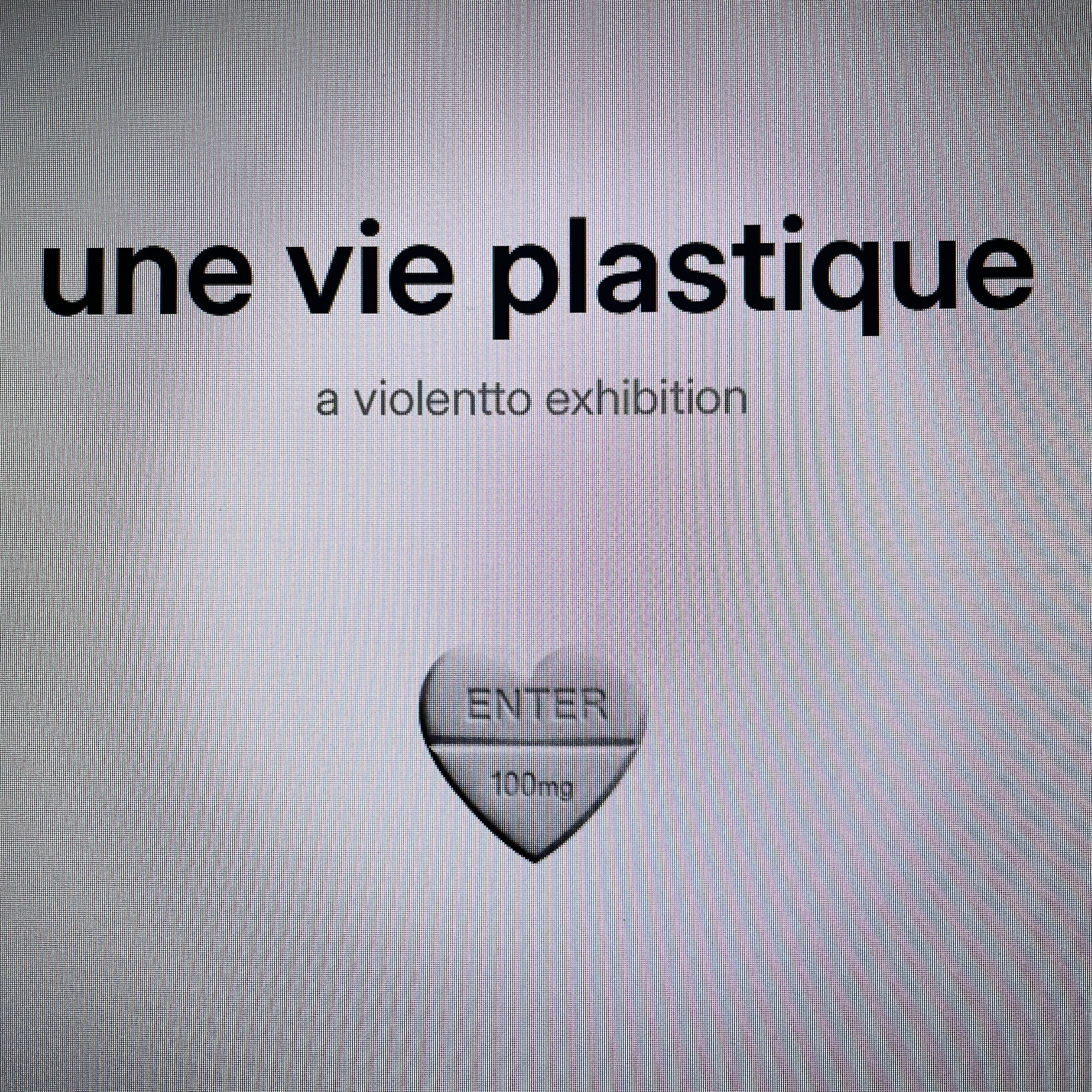
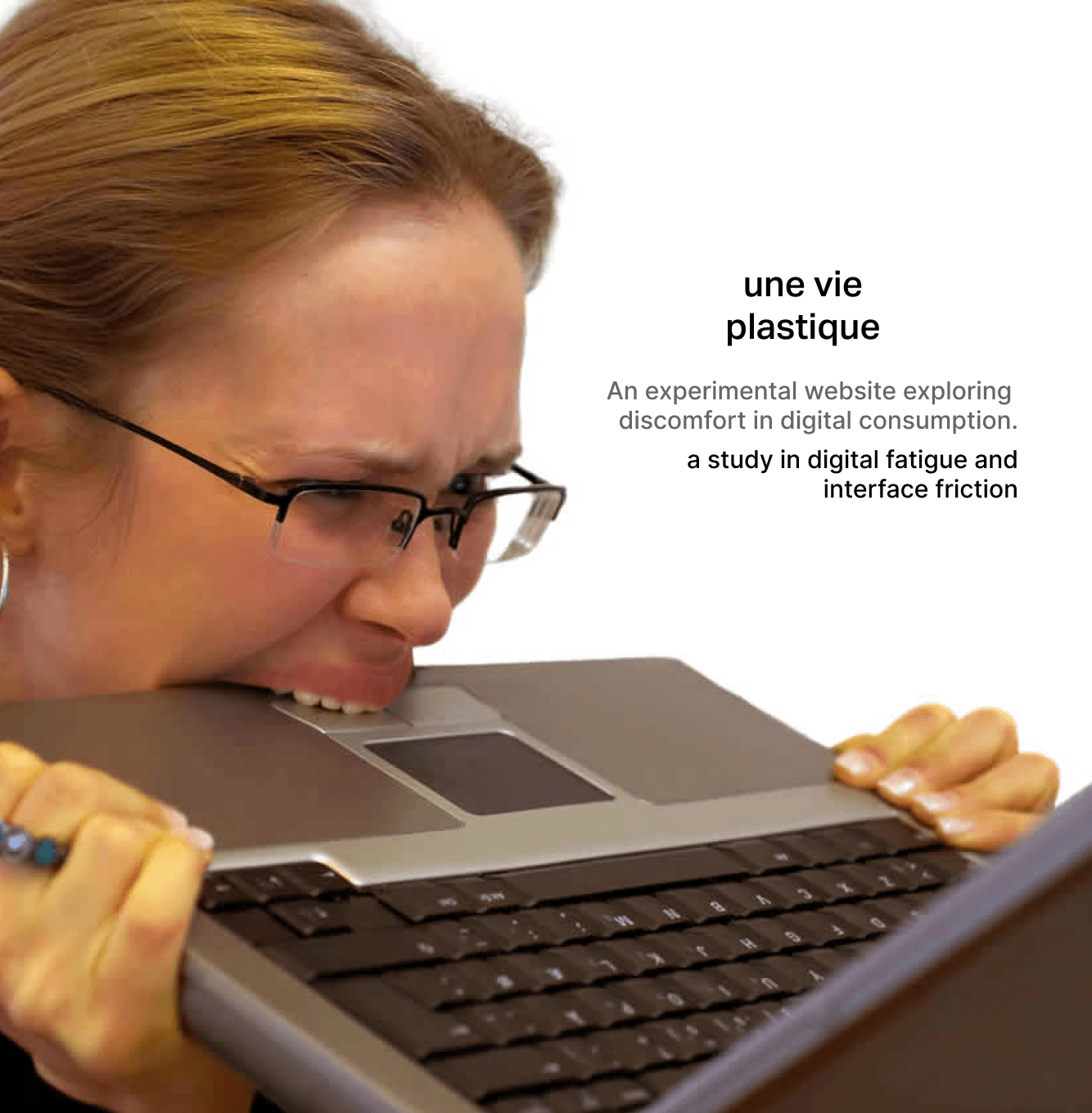
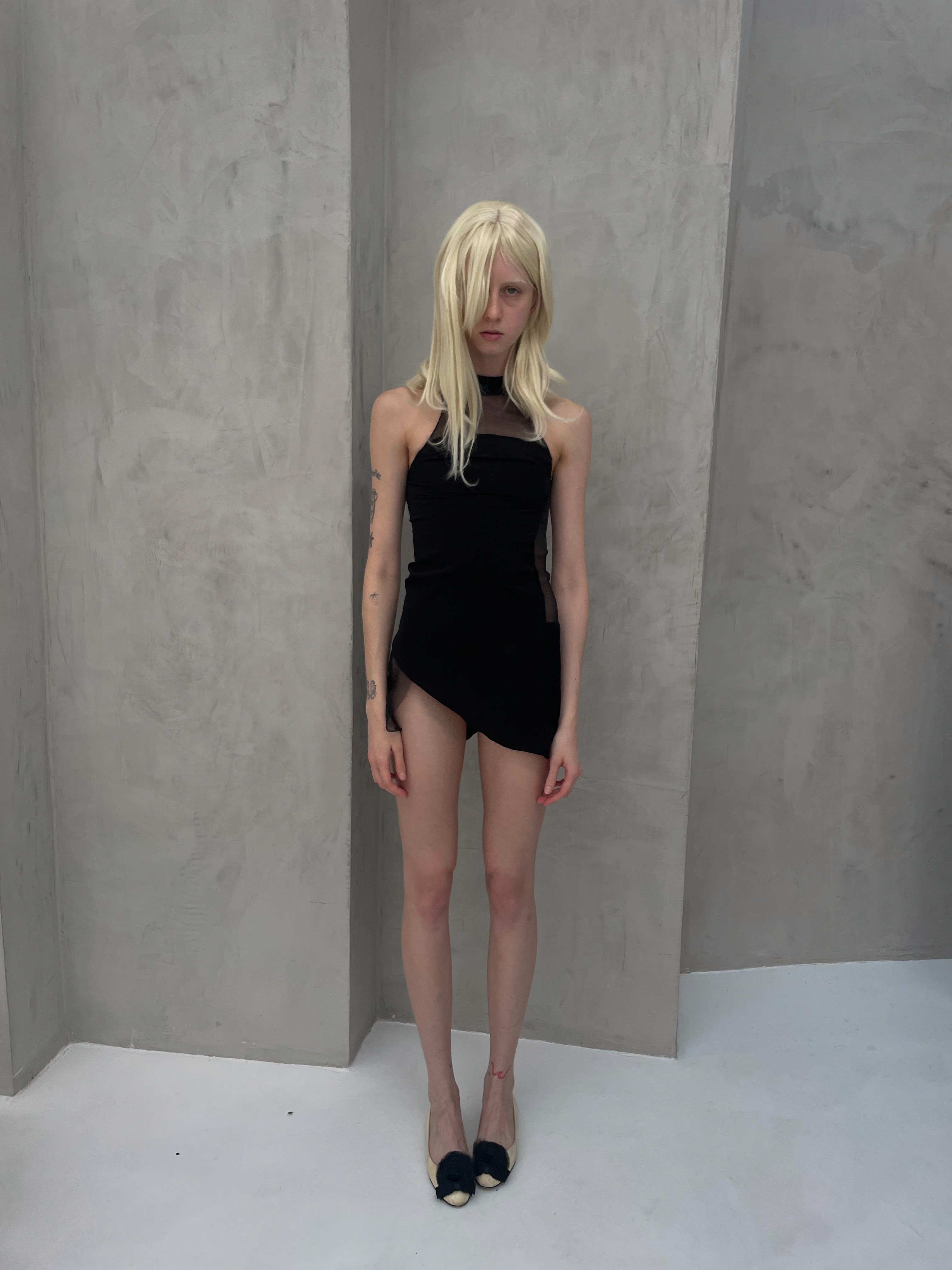
Experimental Anti-Pattern Interface Semiotics. The project simulates social media structures and digital art exhibitions through non-standard layouts, overlapping elements, and controlled viewports. All interfaces, visuals, and content were designed and developed as an experimental study of interaction and narrative on the web.
Category:
Experimental Interface Composition
Client:
Violentto
Duration:
4 - 5 Weeks
Location:
São Paulo, Brazil
Problem Framing & UX Hypothesis
Une Vie Plastique starts from the hypothesis that contemporary digital interfaces have become visually and behaviorally standardized, prioritizing trend replication and surface-level modernity over meaning, authorship, and emotional presence.
The project explores how alternative interface compositions, guided by narrative and intuition rather than optimization and convention, can create experiences closer to how users engage with art exhibitions: without instructions, without hand-holding, and open to individual interpretation.
Design Goals & Interaction Principles
Instead of usability optimization, the primary design goal was to explore alternative interaction principles. Hierarchy, flow, and readability were intentionally destabilized to observe how users navigate interfaces when guidance is minimal and ambiguity is present.
Information Architecture as Narrative
The information architecture does not follow task-based or goal-oriented models. Content is structured as a narrative system, where proximity, scale, and visual contrast replace traditional categorization and navigation patterns.
Visual Hierarchy & Attention Management, exhibit 1.
Exhibit I explores how visual hierarchy can function without clear prioritization. Typography, imagery, and long-form text compete for attention, encouraging scanning rather than linear reading. This is paired with a video interaction that introduces delayed engagement, where user control is partial rather than absolute.
Social Interface as Interaction System, exhibit 2.
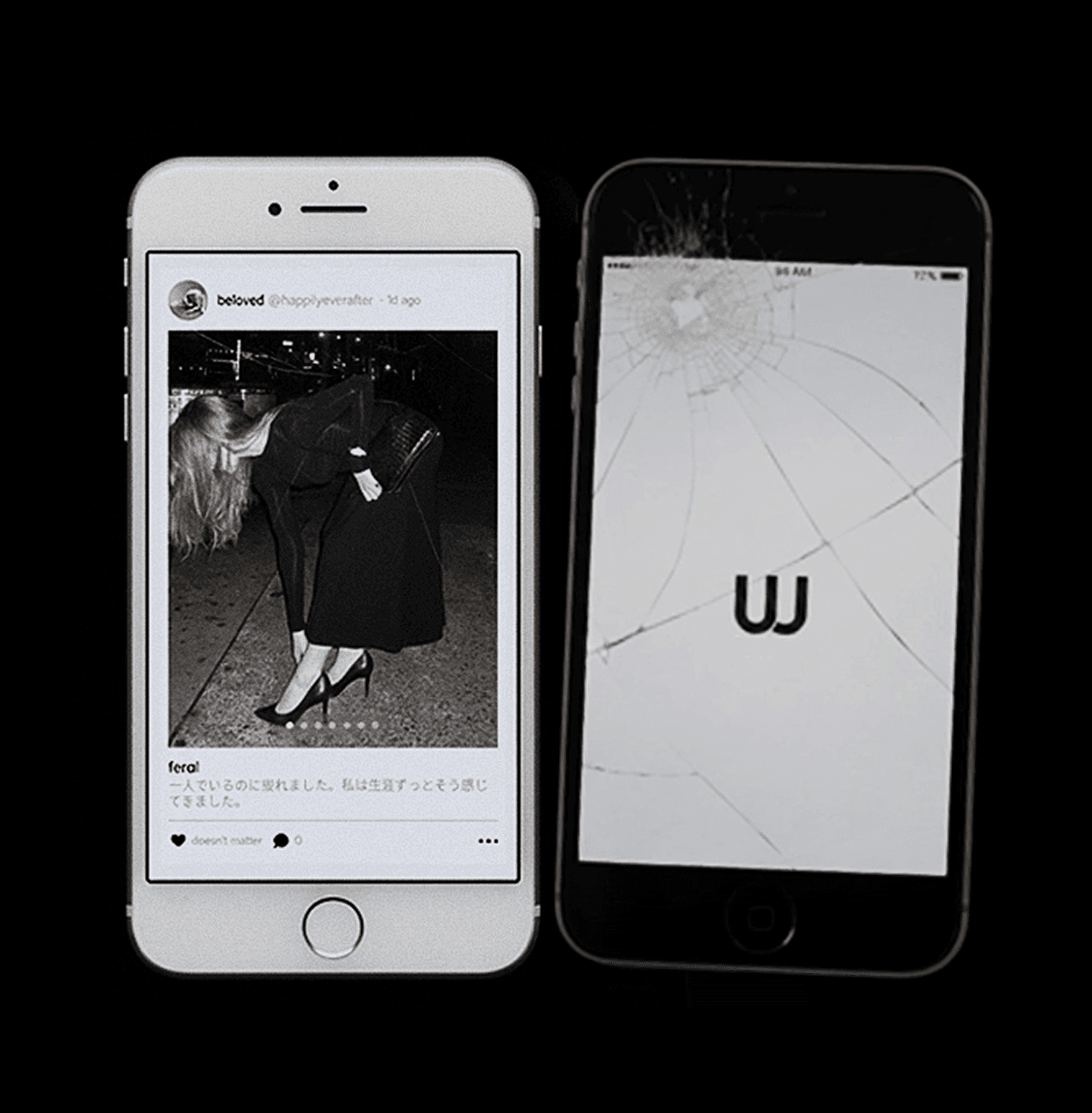
Exhibit 2 treats the social feed as a single composite artifact. A shared image gains meaning only when combined with username, profile photo, caption, and interface structure. What is usually consumed in seconds, shattering attention, is reframed as art and anti-design material through composition rather than content.
Challenging Interface Homogenization
This project questions the increasing homogenization of digital interfaces, where repetition, trend-driven design, and automation often result in emotionally flat and interchangeable experiences. By rejecting conventional UX patterns, we propose narrative-led interaction as an alternative mode of navigation, allowing users to engage through intuition, personal interpretation, and visual reading rather than prescribed flows. The work touches on themes such as digital alienation, aesthetic fatigue, post-social interfaces, and human–machine tension, reframing the website not as a tool to be optimized, but as a space to be interpreted.
Problem Framing & UX Hypothesis
Une Vie Plastique starts from the hypothesis that contemporary digital interfaces have become visually and behaviorally standardized, prioritizing trend replication and surface-level modernity over meaning, authorship, and emotional presence.
The project explores how alternative interface compositions, guided by narrative and intuition rather than optimization and convention, can create experiences closer to how users engage with art exhibitions: without instructions, without hand-holding, and open to individual interpretation.
Problem Framing & UX Hypothesis
Une Vie Plastique starts from the hypothesis that contemporary digital interfaces have become visually and behaviorally standardized, prioritizing trend replication and surface-level modernity over meaning, authorship, and emotional presence.
The project explores how alternative interface compositions, guided by narrative and intuition rather than optimization and convention, can create experiences closer to how users engage with art exhibitions: without instructions, without hand-holding, and open to individual interpretation.
Challenging Interface Homogenization
This project questions the increasing homogenization of digital interfaces, where repetition, trend-driven design, and automation often result in emotionally flat and interchangeable experiences. By rejecting conventional UX patterns, we propose narrative-led interaction as an alternative mode of navigation, allowing users to engage through intuition, personal interpretation, and visual reading rather than prescribed flows. The work touches on themes such as digital alienation, aesthetic fatigue, post-social interfaces, and human–machine tension, reframing the website not as a tool to be optimized, but as a space to be interpreted.
Challenging Interface Homogenization
This project questions the increasing homogenization of digital interfaces, where repetition, trend-driven design, and automation often result in emotionally flat and interchangeable experiences. By rejecting conventional UX patterns, we propose narrative-led interaction as an alternative mode of navigation, allowing users to engage through intuition, personal interpretation, and visual reading rather than prescribed flows. The work touches on themes such as digital alienation, aesthetic fatigue, post-social interfaces, and human–machine tension, reframing the website not as a tool to be optimized, but as a space to be interpreted.

Design Goals & Interaction Principles
Instead of usability optimization, the primary design goal was to explore alternative interaction principles. Hierarchy, flow, and readability were intentionally destabilized to observe how users navigate interfaces when guidance is minimal and ambiguity is present.
Information Architecture as Narrative
The information architecture does not follow task-based or goal-oriented models. Content is structured as a narrative system, where proximity, scale, and visual contrast replace traditional categorization and navigation patterns.
Design Goals & Interaction Principles
Instead of usability optimization, the primary design goal was to explore alternative interaction principles. Hierarchy, flow, and readability were intentionally destabilized to observe how users navigate interfaces when guidance is minimal and ambiguity is present.
Information Architecture as Narrative
The information architecture does not follow task-based or goal-oriented models. Content is structured as a narrative system, where proximity, scale, and visual contrast replace traditional categorization and navigation patterns.
Visual Hierarchy & Attention Management, exhibit 1.
Exhibit I explores how visual hierarchy can function without clear prioritization. Typography, imagery, and long-form text compete for attention, encouraging scanning rather than linear reading. This is paired with a video interaction that introduces delayed engagement, where user control is partial rather than absolute.
Social Interface as Interaction System, exhibit 2.
Exhibit 2 treats the social feed as a single composite artifact. A shared image gains meaning only when combined with username, profile photo, caption, and interface structure. What is usually consumed in seconds, shattering attention, is reframed as art and anti-design material through composition rather than content.
Visual Hierarchy & Attention Management, exhibit 1.
Exhibit I explores how visual hierarchy can function without clear prioritization. Typography, imagery, and long-form text compete for attention, encouraging scanning rather than linear reading. This is paired with a video interaction that introduces delayed engagement, where user control is partial rather than absolute.
Social Interface as Interaction System, exhibit 2.
Exhibit 2 treats the social feed as a single composite artifact. A shared image gains meaning only when combined with username, profile photo, caption, and interface structure. What is usually consumed in seconds, shattering attention, is reframed as art and anti-design material through composition rather than content.
PROJECTS
WORKS (05)
“Attractive things work better.” - Don Norman in The Design of Everyday Things
PROJECTS
“Attractive things work better.”
PROJECTS
“Attractive things work better.” - Don Norman in The Design of Everyday Things
More Works /
More Works /
More Works /


Design Philosophy
FAQ(01)
Design is not just what it looks like and feels like. Design is how it works. - Steve Jobs
Design Philosophy
Design is how it works.
Design Philosophy
Design is not just what it looks like and feels like. Design is how it works. - Steve Jobs
FAQ.
Defining expectations through strategic
alignment and honest answers.
01
What is your background?
02
What is your core expertise?
03
How do you integrate AI into your workflow?
04
How do you approach product scalability?
05
Do you only work in Framer?
06
Can you handle both design and build?
07
What types of projects do you usually work on?
08
What’s your process like?
What is your background?
What is your core expertise?
How do you integrate AI into your workflow?
How do you approach product scalability?
Do you only work in Framer?
Can you handle both design and build?
What types of projects do you usually work on?
What’s your process like?